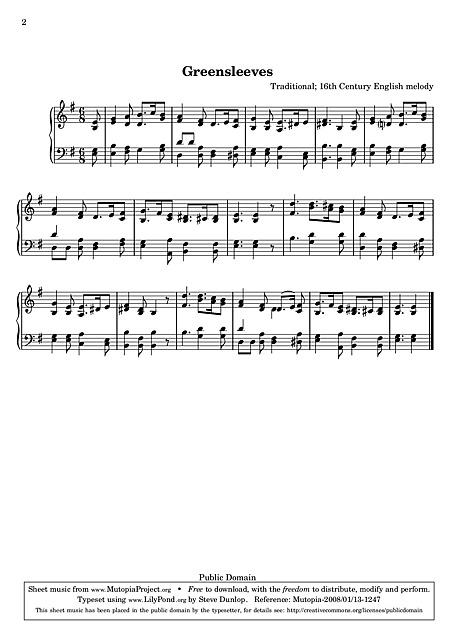
Greensleeves

If you can't open this file, you'll need to install the Adobe Reader.
Music thumbnail
Skini
Slušati
Ovo mi se sviđa

Slušati

Recenzije

Click to rate

O...

O Greensleeves

"Greensleeves" is a traditional English folk song and tune, a ground of the form called a romanesca.

A broadside ballad by this name was registered at the London Stationer's Company in 1580 as "A New Northern Dittye of the Lady Greene Sleeves". It then appears in the surviving A Handful of Pleasant Delights (1584) as "A New Courtly Sonnet of the Lady Green Sleeves. To the new tune of Green sleeves."

The tune is found in several late 16th century and early 17th century sources, such as Ballet's MS Lute Book and Het Luitboek van Thysius, as well as various manuscripts preserved in the Cambridge University libraries.

Greensleeves and Henry VIII
There is a persistent belief that Greensleeves was composed by Henry VIII for his lover and future queen consort Anne Boleyn. Boleyn allegedly rejected King Henry's attempts to seduce her and this rejection may be referred to in the song when the writer's love "cast me off discourteously". However, Henry did not compose "Greensleeves", which is probably Elizabethan in origin and is based on an Italian style of composition that did not reach England until after his death.

Lyrical interpretation
One possible interpretation of the lyrics is that Lady Green Sleeves was a promiscuous young woman and perhaps a prostitute. At the time, the word "green" had sexual connotations, most notably in the phrase "a green gown", a reference to the way that grass stains might be seen on a lady's dress if she had made love outside.

An alternative explanation is that Lady Green Sleeves was, as a result of her attire, incorrectly assumed to be immoral. Her "discourteous" rejection of the singer's advances supports the contention that she is not.

In Nevill Coghill's translation of The Canterbury Tales, he explains that "green was the colour of lightness in love. This is echoed in 'Greensleeves is my delight' and elsewhere."

Alternative lyrics

The hymn What Child Is This? by William Chatterton Dix, set to the "Greensleeves" tune, is used across the Western Christian Church.

A variation was used extensively in the 1962 film How the West Was Won as the song "Home in the Meadow", lyrics by Sammy Cahn, performed by Debbie Reynolds.

Early literary references
In Shakespeare's The Merry Wives of Windsor, written around 1602, the character Mistress Ford refers twice without any explanation to the tune of "Greensleeves" and Falstaff later exclaims:

These allusions indicate that the song was already well known at that time.

Media
"Greensleeves" is often played in Dorian mode and sometimes in the natural minor scale. However, the earliest known source of the tune (Trinity College, Dublin ms. D. I. 21, c. 1580 - known as "William Ballet's lute book") gives the tune in the melodic minor scale.

Other uses
Act 2 Scene 1 of Ferruccio Busoni's opera Turandot opens with the tune, which Busoni thought sounded Chinese.

Ralph Vaughan Williams (1872-1958) composed an orchestral piece in 1934 entitled Fantasia on "Greensleeves".

The above text is available under the Creative Commons Attribution-ShareAlike License ( creativecommons.org/licenses/by-sa/3.0/ ). It uses material from the Wikipedia article "Greensleeves" ( en.wikipedia.org/wiki/Greensleeves ).

Other arrangements

  • Music thumbnail♪HQ
    • Greensleeves
    • Skladatelj
    • Traditional
    • Glazbala
    • Accordian
    • Ocjena
    • 5 od 5

Buy printed editions

We have selected some printed editions we think may be useful.